On Foxes, Trout Lilies & Healing
Notes from a season of regret, late-arriving knowledge, and insufficient advice.

A few weeks ago I saw a fox inspecting a den in the burrow complex beside my home. The next day I happened to look out the window as he arrived at the burrows with five pups trailing single-file behind him, and so I’ve had a front-row seat to fox family life. It is an uncomplicated bliss: the pups alternating between energetic wrestling and cuddle-party slumber, transfixed by leaves and sticks and their own tails, forgetting whatever they’re doing the moment mom or dad appears.
Those are the most beautiful moments of all. The pups and the parents are overjoyed at each reunion, greeting each other in a wriggling crush of nuzzles and tail-wags and body-presses. For a few minutes they are together, a time that mom or dad—only rarely present at the same time, each having a round-the-clock job looking for food—devotes to the never-ending task of grooming their pups’ fur, biting off ticks, and licking their ears, which the pups endure much as human children would: slightly discomfited but clearly enjoying it, sometimes rolling over in eyes-shut delight.
The visits are infrequent given the parents’ schedules, and early on the pups would sometimes wait for them, pressed side-by-side, looking across the field. Once I saw mom waiting with the pups, anticipating dad’s return as eagerly as them; and a couple times I saw mom and dad together, stealing a moment to themselves, as happy to see each other as the pups were to see them.
All this should be joyful. Instead it is bittersweet. Not because I know how fleeting this golden moment is—already the burrow complex is less a nursery than a home base, the pups now disappearing for hours at a time before reconvening, and soon they will make their way in a difficult world where two or three will probably be hit by a car or eaten by a coyote or consume a poisoned mouse or starve before next spring. No, it’s bittersweet because the foxes have something I don’t. Something I didn’t want earlier in life, and only lately, and most likely too late, came to want: family. Children. Someone to wait for me like that. To be that for someone.
For various reasons—the most important, probably, being a childhood and young adulthood in which there were so few happy families that marriage and parenthood never became templates of realistic possibility—I did not want marriage or a family when I was young. In relationships I was happy to share a life but didn’t feel in my bones the urge to build a shared future. When I was single I rarely felt lonely, and though friends told me what a good father I would make, it seemed like something one should only do if one truly, deeply wanted it, and I couldn’t say that. For all I enjoyed being with my friends’ children, I no more imagined myself as a husband and father than I imagined switching careers and becoming a chef. It didn’t seem undesirable or impossible; it simply didn’t come to mind. And so I built a life that didn’t have these things, but within which I was content, even happy: people I loved, work that was fulfilling, pastimes and enthusiasms, creature comforts. Looking back, I wonder if some of that was avoidance—a young man’s sense, one I should have outgrown long ago, of time and possibility still stretching ahead farther than I could see. Then last fall I was in a relationship and when it ended all that was blown apart.
Now, you probably subscribe to this newsletter because you’re interested in nature and animals, not my personal life, and I’ve always been inclined to keep my private world separate from my public self, especially on social media. Being public with myself feels uncomfortable and as a reader I’m allergic to anything that feels like a demand for attention. But the gap between my public presence and private reality has felt so wide as to be dishonest, or at least uncomfortably inauthentic. In this new chapter of my life I’ve also been grateful for the help I’ve received and frustrated by how hard it is to find words that speak to me, particularly on the subject of regret. Maybe these words will be useful to someone else.
“My life came to a standstill. I could breathe, eat, drink, and sleep, and I could not help doing these things; but there was no life, for there were no wishes the fulfillment of which I could consider reasonable,” wrote Tolstoy in A Confession. “If I desired anything, I knew in advance that whether I satisfied my desire or not, nothing would come of it.”1 It’s a concise description of severe depression and the anhedonia, or lack of positive feeling, that comes with it. Something I had no understanding of before the storm of grief, regret, and depression—interlocked, each feeding the others, cycling—I was in for most of the past seven months. The experience, now that I’m at least not drowning in it, was revelatory in some ways: I had not appreciated how the valence of everyday life, of going about one’s tasks and routines, of having interests and preferences and curiosity, actually feels good. How, without even being aware of it, one is unconsciously looking forward, anticipating, hoping: a sort of emotional background hum so constant that one only notices when it stops.
It stopped. Nearly everything that gave me pleasure or satisfaction no longer did. Music, shows, stories, nature—to which I’ll return in a moment—felt like nothing, except for when they were reminders of loss. When I learned that a story of mine was selected for this year’s Best American Science and Nature Writing anthology, an honor I’ve long wanted, I felt blank; and work, which for all the frustrations of freelance life in a troubled industry has brought fulfillment and a sense of service, was its own cruel reminder, for the way I let work subsume my life without even realizing it had been part of the problem. And work, of course, won’t love you back.
The only thing that maintained its previous power, surviving even that deep freeze, was talking to people I cared about or to whom I felt connected. But that could only fill so many hours in a day, and anhedonia’s unique cruelty is that even as the capacity to feel good is muted, the capacity to feel bad remains intact. Meanwhile the depression was deepened by the grief, which in neurobiological terms can be understood as the feeling produced by a mismatch between one’s internal model of the world and its reality. The mind seeks the lost person and does not find them; that person is not only themself but woven into a web of associations so dense that one’s mind is constantly reminded of them and thus their loss. Coffee, birdsong, cooking, sunlight: all loss. The poet W.S. Merwin captured the truth of this: “Your absence has gone through me / Like thread through a needle / Everything I do is stitched with its color.”
I not only grieved the person I lost and the future I hoped for, I realize now, but also how I only belatedly became someone for whom marriage and family—not just having that for myself, but the possibility of being that for someone else—had come so late. The grief fueled the depression; regrets—of the loss, the blind spots and habits that contributed to it, of not loving well enough, of misunderstanding, of how it ended, of gifts ungiven, of time passed—fueled the grief; depression fueled the regrets. An ocean of them, a regret with every reminder. I am also prone to rumination and that makes regrets especially hard, as my mind worries them like a dog on a bone. And in the world of self-help and therapy and psychology into which I burrowed this winter, seeking refuge in understanding, I found little help for my regrets. I’m tempted to say no help, but that would be hyperbole, and in any case I can’t know. I would likely be in much worse shape without the counsel and insight I received. But the help was insufficient.
Take, for example, the advice that hindsight’s clarity is deceiving, that I did my best with the tools I had at the time, and could only know what I knew when I knew it. True enough—and were self-blame my problem, it might help—but what did that matter? It did not touch the loss at the heart of it all, nor the longing beneath the loss. It did not touch the pain of realizing that what could have changed the outcome was so very simple, within my grasp at the time or easily learned, only I didn’t know to reach for it. And so it was for all those cognitive reframing devices that are commonly offered as solace for the heartbroken: I could only be responsible for my part. I was oversimplifying a complex system of different attachment styles, histories, and patterns. I didn’t just miss the person but rather who I was with them. It wasn’t a verdict on my worth. I should be compassionate with myself and treat myself as I would a friend. Regret was motivation and information. I had grown and expanded, and would take what I learned into my next relationship—a piece of advice that was painful in itself, for the relationship that mattered was the one that was gone.
All that advice was true to a point. None of it made a difference to the pain of loss and longing, nor the salted wound of knowledge gained too late. And of the broader regret, of coming late to a desire for lifelong partnership and fatherhood, I found some advice: the lost future I lamented was a rose-tinted fantasy that could have turned out terribly. The person I am now is the product of my experiences; were those different I would be someone else, and to lament an unlived life was to feel regret for someone else.2 Those perspectives rang true. Again they didn’t touch the hurt.
Maybe it was a mistake to seek relief, though, to think some understanding would make me feel better. Some hurts you just carry—and the only respite came in sharing them with a friend, bearing them alone but in company. I now have a soft spot for Niobe, a figure from Greek mythology whose prideful boasting cost the lives of her children; there was nothing to be done but weep, which she did without ceasing until finally she was transformed into a mountainside stone from which water flowed. There was no arc of redemption, no lessons learned, only sorrow to be borne.
There is truth in that. And also a warning about grief unmetabolized into growth and service. No wonder the more common mythological archetype is of grief and hindsight put to good use. Indeed the oldest known recorded story, the epic of Gilgamesh, is a tale of loss that exposes a flaw and leads to self-knowledge and wisdom, which is subsequently used to benefit his community. So too Heracles, Oedipus, Ashoka, Iris, Demeter, King Lear, Darth Vader, Tony Stark. For what good is it to become a stone?
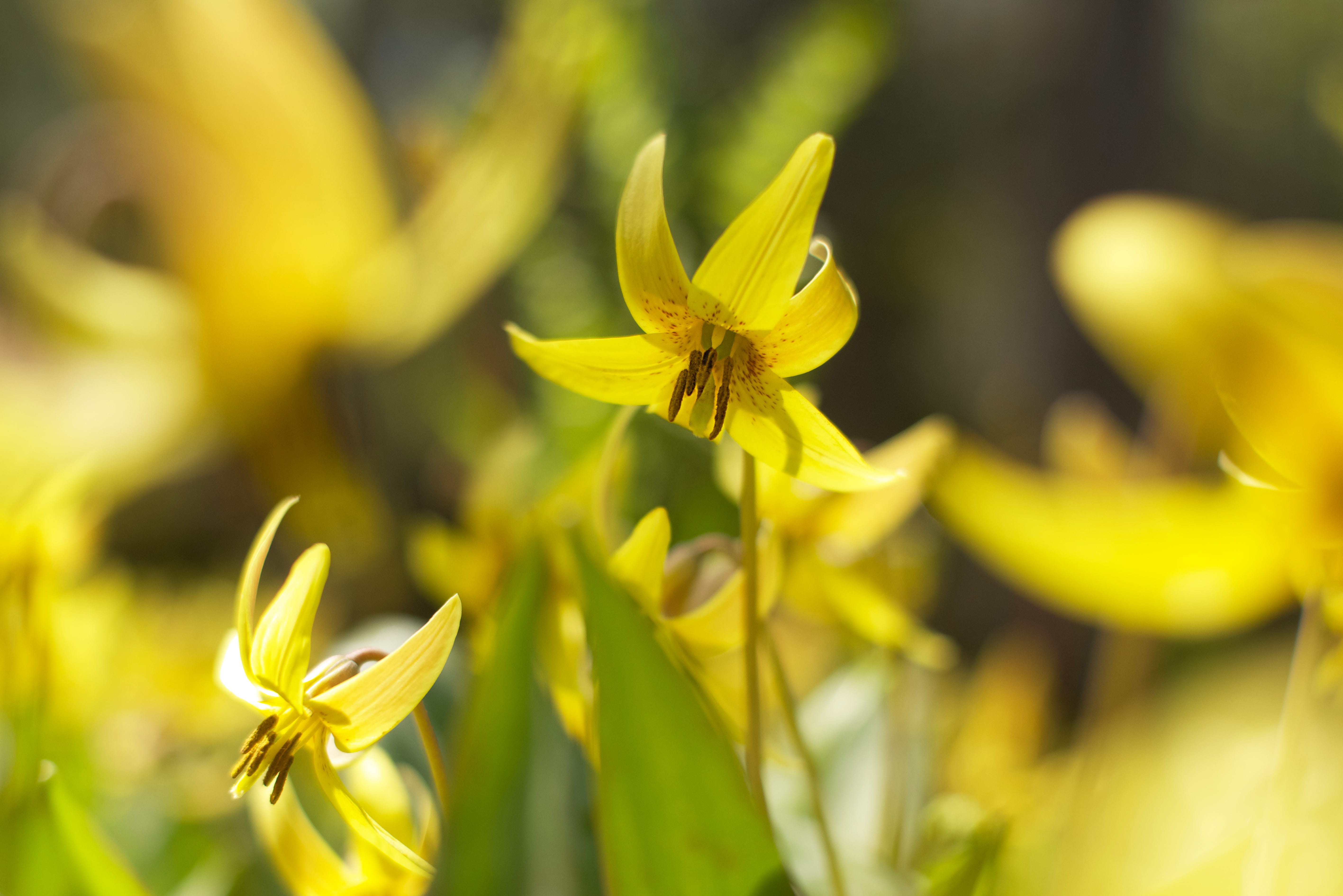
On late April and early May mornings I like to walk to the stream behind my house. Along its banks are a colony of trout lilies. They stretch for hundreds of feet and are perhaps as many years old, a congregation of bright yellow blossoms nodding in the breeze. They bloom after the earth’s thaw and before the trees standing amidst them leaf out; they return last year’s sunshine and upland nutrients carried on snowmelt and spring rainfall. The year’s first bumblebees attend to them.
For years it’s been my ritual to photograph the trout lilies, which is less about photography than it is an excuse to lose myself in the moment: in the crisp spring breeze, the bright clear sunshine, the feelings the lilies bring. Trout lilies, like many spring ephemerals, are symbols of rebirth, of resilience, for good reason. All life is part of a cycle; few embody the cycle so well. To crouch on the earth among them is to be part of it.
This spring, however, I’ve only gone once. One casualty of the breakup was my connection to nature. Part of that is the anhedonia: the very systems that find pleasure in beauty and wonder, at the sight of intricately tangled roots or a sunset’s gradient or the vibrant green found only in canopies of unfurling leaves, being offline. But the natural world is also closely associated with the woman I lost. The blossoms, the sunset, the green, all of them are tinted with absence. Nature, the world where I would otherwise find solace, is now intertwined with what I’ve sought solace from.
There’s also a newfound dissatisfaction with experiencing nature only for myself, a sense of that not being enough. One realization of this time is that I’ve been too self-oriented: not self-centered nor selfish, but not consistently looking outwards. It’s the difference between being generous and empathetic when called upon, and of making it a practice, a way of being. Another realization has been how right it feels to be of service; that what matters more than anything is mattering to someone else. I had known that, but I hadn’t known it. Depression is a funhouse mirror, leaving one to question whether any given insight was real or just a distortion, but I know that to be true.
I expect this disconnection with nature to pass. Claude, when asked to provide counsel using the insights of Pauline Boss and other experts on what is called ambiguous loss—and yes, I’m aware of the complications of using AI as a therapist—says that my relationship to nature will return as the anhedonia lifts and new associations form.3 It will take a while, says Claude, and I won’t have the same relationship; it would help to find new places and customs, to allow a walk in the woods to be a place where grief exists, to experience nature with others. This spring I’ve taught two nature-writing workshops and both were very satisfying. Maybe the new relationship to nature will include more sharing with people who are physically present as well as those who are distant. (The foxes, I should say, though bittersweet in a new way, are still a source of joy.)
Maybe I’ll visit the trout lilies again while they still bloom, but I’m not sure. I had a few moments of engagement on my visit, it wasn’t quite unpleasant, but I couldn’t find the sun-dappled transcendence they usually bring. It stings to feel less than I once did. Spring always pulls me into the world; now I pull back from it. There is a phenological mismatch between the season and my emotional climate. A part of me also shrinks from the trout lilies’ symbolism.
Rebirth and resilience: Aren’t those just the meanings we’ve pushed upon them? An ecological truth but a wishful projection. Sometimes—oftentimes, in the times it matters most—there is no rebirth, at least not in the way we’d like. What is lost does not come again. A life will not return, nor a love, nor even a chance. There is no universe in which I can go back in time and apply what I’ve learned; that there is no direction but forward is truth, but it’s not easy to make peace with that. This spring I struggle to find meaning in the lilies—but maybe that’s why I should visit. Perhaps that is why they need to be a symbol.
I encountered this quote in Kieran Setiya’s Midlife, in the chapter on personal regret. Having read the quote, Setiya then says: I don’t feel this way and I hope you don’t either. Thanks for all the help, Kieran.
Kieran Setiya nailed this one too. On the subject of regrets about not having children, he offered the example of Virginia Woolf: she regretted being childless, but she also wrote Orlando and To The Lighthouse and Mrs. Dalloway—so it was worth it. Great advice if you’re a brilliant writer who will alter the course of English literature. As for terrible, searing regrets, advises Setiya, they often don’t heal, so best not think too hard about what might have been.
There’s a right way to use chatbots for mental health, I think. It involves treating them as informed interlocutors: potentially insightful, also fallible, something to consider but not accept as definitive. The same goes for the Reddit forums, wounded friends, YouTube influencers, and middling therapists from whom people seek psychological help.